Fun with Argon
NEW - The argon blowtorch! More fun with argon here
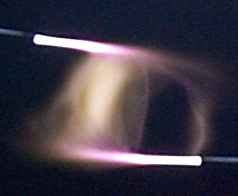
Tesla coil discharges inside a jar of argon welding gas. Note the glow from the gas-filled nylon tubing, which actually looks brighter than it appears in this photo.

What I was actually trying to do before this was fire jets of argon at the toroid using a pulsing solenoid valve and a thin metal nozzle (1mm dispensing syringe nozzle), in the hope of making a 'laser gun' discharge effect, but it was only visible for about half an inch out of the end of the tube - maybe I need to make a laminar flow nozzle - any ideas anyone?
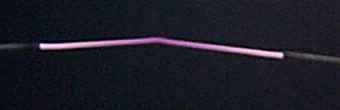
When I noticed the tube glowing, I thought this would be fun to investigate further. I made a couple of 'argon tubes' by filling 1-foot lengths of 4mm yellow nylon pneumatics tubing with argon, and sealing with large (yellow size) crimp terminals over the tube, after first threading a very thin bare copper wire into each end to act as electrodes. I filled one tube at about atmospheric pressure, and one at the full pressure I could get out of the regulator (about 60psi). The low pressure one only lasted for about 24 hours, but the high pressure one is still going after 4 days - I presume the pressure reduces contamination of the gas from the tubing, although I also sealed the high pressure one with hot-melt glue after crimping, so the other one may have just been leaky. Watch this space for further developments!
WARNING They get quite hot after only a couple of few seconds, and will probably burst if pressurised, possibly flinging out hot plastic fragments - take care!
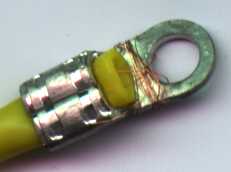
The picture below doesn't really show the brightness that well, but you can see the reflected yellow light on top of the toroid. It's also rather blurred because the tube was swinging around a bit. The right-hand picture shows the crimped end - you need a good ratchet-type crimp tool - the cheap plier type ones won't work very well. The yellow insulating sleeve was removed from the terminal before crimping. A single strand of very thin (0.07mm) wire was inserted in the tube to act as an electrode, and the tube crimped over it.

Welding argon is obtainable at good tool and motor suppliers - I got mine at a large branch of Halfords, along with a regulator (both made by SIP), which screws onto the cylinder, and has a push-fit connector for 4mm nylon tubing. Don't get Argon/CO2 mix, it won't work.
The Argon Blowtorch
Whilst playing around with Jacob's ladders recently, I
wondered what would happen if you blew some argon across the gap. I used some small 1mm
stainless steel fluid dispensing needles (which push-fit perfectly on 4mm tubing) to
create thin jets of gas, which ionise much more readily than the surrounding air. My
10KV-odd transformer pair needs a gap of about 0.25" to initiate an arc in air,
but it arcs about 1.5 inches through the argon jet, looking like an extremely fine torch
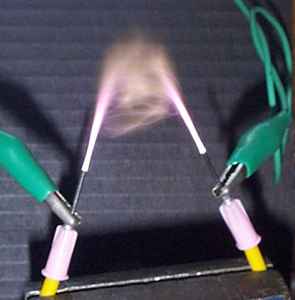
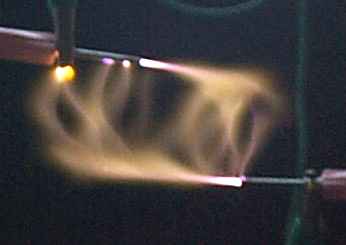
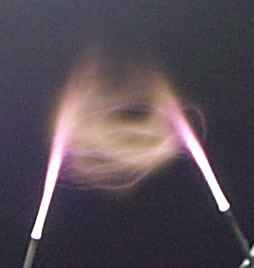
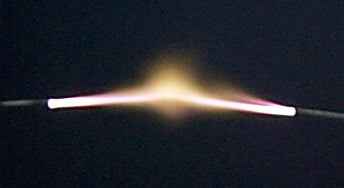
flame. Encouraged by this, I tried creating arcs between two argon jets, as shown
below. Interesting effects can be seen depending on how the streams collide, as the
gas mixes with air, increasing its breakdown voltage. You tend to get a hybrid argon and
air discharge, blue-white at the nozzles, changing to the pinkish air discharge in the
middle.
Gas flow rate doesn't make a huge difference - in general, if you can hear it hissing out
of the nozzle (when not discharging), you're wasting gas as it works just as well at lower
flow rates. Different nozzle shapes may improve the 'flame' length if they achieve a less
turbulent flow.
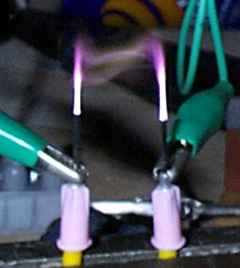
As the voltage is increased,towards the breakdown voltage, you initially get very dim blue
'flames' around the nozzles, which get longer, until they get close enough to 'light up'
and form a heavy bright discharge.
The nozzles are between 1 and 2 inches apart in the images below.